
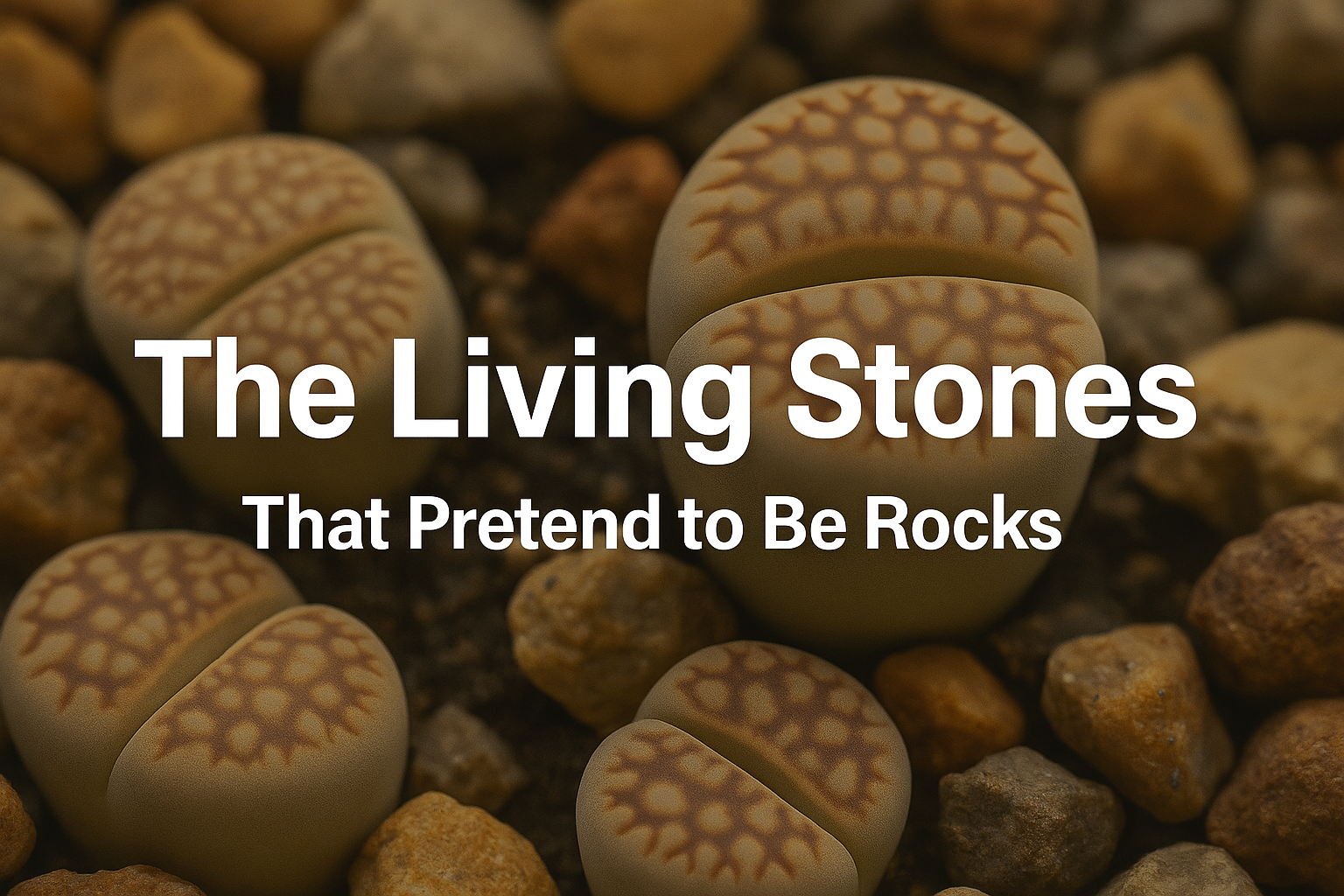

# **The Living Stones That Pretend to Be Rocks**
In the harsh deserts of southern Africa, a botanical master of disguise hides in plain sight. **Lithops**, commonly called “living stones,” have evolved to look exactly like the rocks and pebbles around them—a survival strategy so effective that even experienced botanists sometimes struggle to spot them.
These incredible succulents don’t just mimic stones; they’ve developed **unique water storage systems, underground growth habits, and deceptive flowering patterns** to thrive where most plants would perish.
This article uncovers the secrets of living stones, from their **evolutionary tricks to their surprising role in illegal plant trafficking**, and why scientists believe they may hold clues for **drought-resistant agriculture**.
—
## **What Are Living Stones?**
**Lithops** (from Greek *lithos* = stone, *ops* = face) are small, stemless succulents native to **Namibia, South Africa, and Botswana**. Of the **37+ known species**, each mimics the specific rocks of its habitat—whether quartz, sandstone, or limestone.
### **Key Features That Make Them “Invisible”**
✔ **Rock-like appearance** – Patterns match local stones (dots, wrinkles, colors).
✔ **Buried bodies** – Only the leaf tips peek above ground.
✔ **Seasonal camouflage** – Some change color with rainfall.
—
## **How Living Stones Fool Everyone (Including Animals)**
### **1. The Ultimate Mimicry: Stone or Plant?**
– **Gazelles and tortoises** often step right over them.
– **Human collectors** must crawl on hands and knees to find them.
### **2. Clever Water Storage System**
– **96% of plant body** stays underground to avoid evaporation.
– Special **”window cells”** on top filter sunlight for photosynthesis.
### **3. Bizarre Growth Cycle**
– **Split like an alien egg** annually, growing new leaves inside old ones.
– Old leaves shrivel into a **natural water reservoir** for the new pair.
—
## **The Secret Sex Life of Living Stones**
### **1. Flowers That Defy Expectations**
– Bloom **bright white or yellow** in autumn—when nothing else flowers.
– Scentless (no need to attract pollinators in barren deserts).
### **2. Underground Pollination Mystery**
– Some species may self-pollinate **before flowers even emerge**.
– Tiny beetles are suspected pollinators.
—
## **Illegal Trade: Why Poachers Risk Jail for These Stones**
### **1. The Black Market for Rare Lithops**
– **L. coleorum** (only 10 plants known in wild) sells for **$300+ illegally**.
– Social media fuels demand, with hashtags like #LivingStoneLoot.
### **2. Conservation Efforts**
– **CITES Appendix II** protects most species.
– **Seed banks** preserve genetic diversity.
—
## **Growing Living Stones at Home: A Challenge**
### **Do’s and Don’ts**
✔ **Do** use **90% grit, 10% soil** mix (mimics desert).
✔ **Do** water **only 3-4 times a year** (October-April).
❌ **Don’t** water in summer (they’ll melt into mush).
❌ **Don’t** repot often (roots hate disturbance).
### **Why They Die in Normal Pots**
– **Tap water minerals** clog their tiny water-absorption hairs.
– **Humidity** causes fungal explosions.
—
## **Scientific Research: Could Lithops Save Crops?**
### **1. Drought-Proof Farming Clues**
– Their **”leaf-splitting” water storage** inspires irrigation tech.
– Genes for **UV resistance** could help climate-stressed crops.
### **2. NASA’s Interest**
– Testing if lithops could grow in **Martian regolith**.
– Their low-water needs ideal for space colonies.
—
## **Where to See Them in the Wild (Ethically)**
– **Richtersveld Desert (South Africa)** – Guided tours only.
– **Karoo National Park** – Home to **L. optica**, the rarest blue-gray species.
**Rule:** Never dig them up—**fines reach $10,000**.
—
## **Conclusion: Nature’s Greatest Impersonators**
Living stones prove evolution is the ultimate artist. By becoming nearly indistinguishable from rocks, they’ve survived **60 million years** in Earth’s driest places. Now, as climate change threatens deserts, these unassuming plants may teach us how to **conserve water, restore degraded lands, and even farm on other planets**.
Next time you see a pebble in the desert… look closer. It might be watching you back.


Leave a Comment