
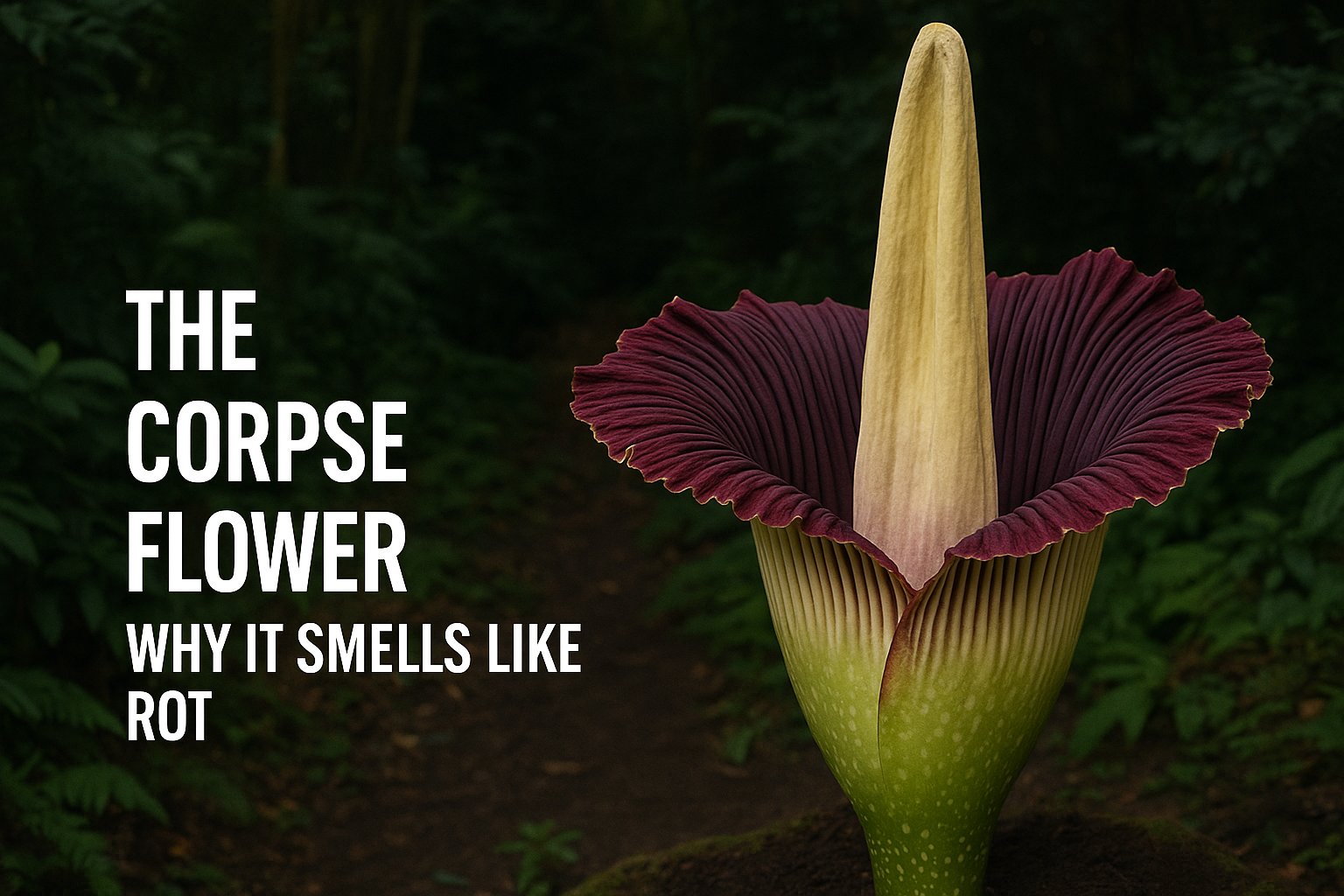

The Corpse Flower, scientifically known as Amorphophallus titanum, is one of the most bizarre and fascinating plants in the world. Its enormous size and putrid stench—often compared to rotting flesh—have earned it a notorious reputation. But why does the Corpse Flower smell so foul? And how does this strange adaptation help it survive?
In this article, we’ll explore:
-
The biology behind the Corpse Flower’s infamous odor
-
How its smell attracts pollinators
-
Where it grows and how rare it is
-
Why it’s such a spectacle in botanical gardens
-
Fun facts about this stinky giant
By the end, you’ll understand why this plant is both revolting and remarkable.
Why Does the Corpse Flower Smell Like Rotting Flesh?
The Corpse Flower’s overwhelming stench isn’t just a random trait—it’s a highly evolved survival strategy. When the plant blooms (which happens only once every 7-10 years), it releases a cocktail of foul-smelling chemicals, including:
-
Dimethyl disulfide (smells like rotting onions)
-
Trimethylamine (found in decaying fish)
-
Isovaleric acid (reminiscent of sweaty socks)
-
Indole (present in human feces)
This nauseating mix mimics the scent of a decaying animal, which serves a crucial purpose: attracting pollinators.
The Science Behind the Stink
Unlike sweet-smelling flowers that lure bees and butterflies, the Corpse Flower targets carrion beetles and flesh flies—insects that feed on dead animals. By smelling like a rotting carcass, the plant tricks these insects into visiting, hoping to lay their eggs.
When the bugs crawl inside the flower’s deep central chamber (called the spadix), they get covered in pollen. Since the flower’s scent only lasts 24-48 hours, the insects quickly move on, carrying pollen to other Corpse Flowers and ensuring cross-pollination.
Where Does the Corpse Flower Grow?
The Corpse Flower is native to the rainforests of Sumatra, Indonesia, where it thrives in hot, humid conditions. Due to deforestation, it’s now classified as endangered in the wild.
However, botanical gardens worldwide cultivate these plants, where they become major attractions during their rare blooms. Some famous Corpse Flowers include:
-
“Titan Arum” at the Royal Botanic Gardens, Kew (one of the most viewed blooms)
-
“Morticia” at the Chicago Botanic Garden
-
“The Beast” at the University of Wisconsin-Madison
Because they bloom so infrequently, seeing (and smelling) one is a once-in-a-lifetime experience for many.
The Lifecycle of the Corpse Flower
The Corpse Flower has one of the most unusual growth cycles in the plant kingdom:
-
Dormant Phase (Years 1-7+) – The plant grows a single, massive leaf, storing energy in its underground corm (a bulb-like structure).
-
Blooming Phase (Once Every 7-10 Years) – The leaf dies, and a towering flower spike emerges, reaching up to 10 feet tall.
-
Pollination & Seed Production – If pollinated, it produces bright red berries. If not, the plant returns to dormancy.
The entire process is energy-intensive, which is why blooms are so rare.
Why Is the Corpse Flower So Popular?
Despite its revolting odor, the Corpse Flower draws massive crowds whenever it blooms. Here’s why:
✅ Rarity – Blooms are unpredictable and infrequent.
✅ Gigantic Size – It’s one of the largest flowers in the world.
✅ Shock Factor – Few plants smell this bad!
✅ Scientific Wonder – Its heat-generating ability (thermogenesis) helps spread its stench further.
Many botanical gardens livestream blooms, and some even host “Stink Watch” events where visitors line up for a whiff.
Fun Facts About the Corpse Flower
-
Nicknames: “Titan Arum,” “Corpse Plant,” “Stinky Flower”
-
Heat Production: The spadix can reach human body temperature, enhancing the rotting smell.
-
World Record Holder: The tallest bloom ever recorded was over 10 feet tall.
-
Not Actually a Single Flower: It’s an inflorescence—a cluster of tiny flowers.
-
Short-Lived Stench: The smell peaks at night and fades within 48 hours.
Conclusion: Nature’s Most Deceptive Flower
The Corpse Flower’s disgusting odor is a brilliant example of evolutionary adaptation. By mimicking a rotting corpse, it ensures its survival in the competitive rainforest ecosystem.
While most people wouldn’t want this stinky giant in their backyard, its rare and dramatic blooms make it a must-see spectacle for botanists and curious visitors alike.
Want to See (and Smell) a Corpse Flower?
Check botanical gardens like:
-
Huntington Library (California)
-
United States Botanic Garden (Washington, D.C.)
-
Atlanta Botanical Garden (Georgia)
Keep an eye out for bloom announcements—you might just get a chance to experience this natural wonder (and its unforgettable stench)!


Leave a Comment