
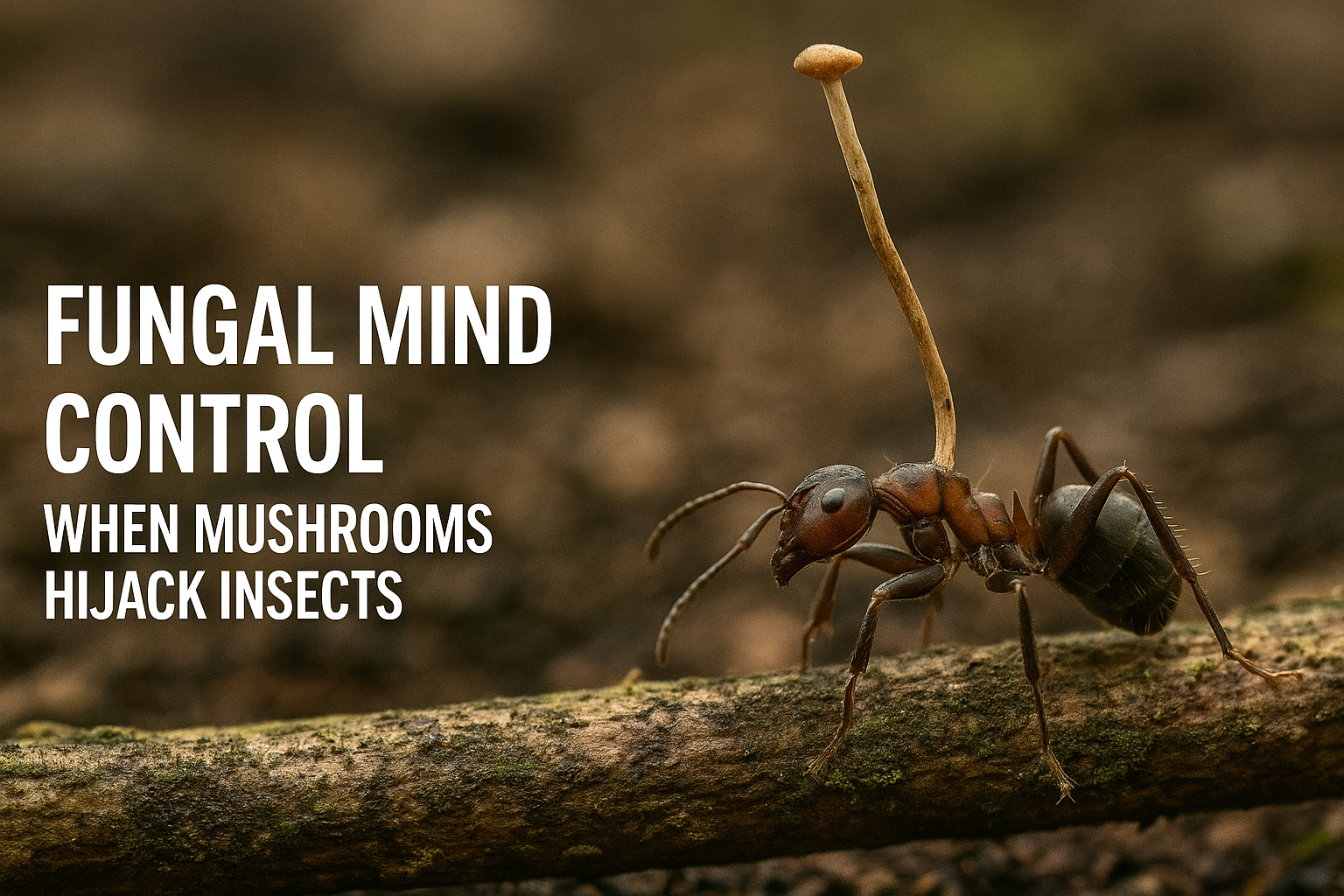

In the hidden corners of forests and jungles, a silent war rages—one where fungi turn insects into zombies, manipulating their bodies and minds before killing them in gruesome yet calculated ways. These are not scenes from a horror movie but real-life examples of fungal mind control, where mushrooms evolve to dominate their hosts with terrifying precision.
From “zombie ants” climbing to their deaths to flies turned into spore-spreading puppets, this article uncovers the science behind fungal manipulation, the most notorious mind-controlling species, and how researchers are studying these parasites for medicine, pest control, and even biotechnology.
How Do Fungi Control Insects?
Fungal mind control is a form of parasitic manipulation, where a fungus infects a host and alters its behavior to benefit the fungus’s reproduction. The process typically follows these steps:
-
Infection – Spores attach to the insect’s exoskeleton and penetrate its body.
-
Colonization – The fungus grows inside, avoiding the immune system.
-
Mind Control – Chemicals alter the insect’s brain, forcing it to behave abnormally.
-
Death & Spread – The host dies in a position ideal for spore dispersal.
Key Fungal Manipulation Tactics
-
Neurological Hijacking – Fungi secrete compounds like guanine and psilocybin analogs that disrupt insect brains.
-
Muscle Control – Some fungi paralyze or hyperactivate muscles.
-
Death Positioning – Infected hosts often climb and latch onto elevated surfaces before dying.
The 5 Most Terrifying Mind-Controlling Fungi
| Fungus | Host | Manipulation | Horror Factor |
|---|---|---|---|
| Ophiocordyceps unilateralis | Ants | Forces ants to bite leaves before death | “Zombie ant fungus” – inspired The Last of Us |
| Entomophthora muscae | Houseflies | Makes flies perch upside down, then explodes spores | Spores burst from the fly’s body at noon |
| Massospora cicadina | Cicadas | Turns cicadas into hypersexual spore spreaders | Genitals fall off, replaced by fungal plugs |
| Hirsutella thompsonii | Mites | Forces mites to climb plants and die at the tips | Used as a natural pesticide |
| Pandora formicae | Ants | Causes ants to wander away from colonies before death | Fungus glows under UV light |
Ophiocordyceps: The Original Zombie Maker
The Lifecycle of a Zombie Ant
-
Spores attach to an ant’s exoskeleton.
-
The fungus digests the ant from inside, avoiding vital organs to keep it alive.
-
Chemicals force the ant to climb to a high leaf or twig.
-
The ant bites down in a “death grip” (mandibular lock).
-
The fungus kills the ant, then grows a spore-releasing stalk from its head.
Why This Behavior?
-
Elevation helps spores spread farther.
-
The death bite ensures the ant stays in place.
Did The Last of Us Get It Right?
-
The game/show exaggerates human infection (real Ophiocordyceps only targets insects).
-
However, real fungi do control behavior—just not at pandemic scales.
Entomophthora: The Exploding Fly Fungus
A Gruesome Death Ritual
-
Infected flies are forced to climb upward (a behavior called “summit disease”).
-
At solar noon, the fungus bursts from the fly’s body, releasing spores.
-
Nearby healthy flies get infected by the cloud.
Why Does Timing Matter?
-
Noon is when flies are most active, increasing spore spread.
-
Sunlight triggers the fungal explosion.
Massospora: The Cicada STD That Replaces Genitals
The Most Bizarre Manipulation
-
Infects cicadas during their 17-year life cycle.
-
Chemicals induce hypersexuality—infected cicadas mate obsessively.
-
Their genitals fall off, replaced by fungal spores that spread during mating.
Why This Strategy Works
-
Cicadas only emerge en masse every 17 years, so the fungus must spread fast.
-
Sexual transmission ensures maximum reach.
Could Fungal Mind Control Affect Humans?
The Short Answer: No (For Now)
-
Most parasitic fungi are highly host-specific.
-
Human body temperature (37°C/98.6°F) kills most insect-targeting fungi.
But… There Are Odd Exceptions
-
Candida auris – A drug-resistant fungus spreading in hospitals.
-
Cryptococcus neoformans – Can infect human brains (but doesn’t control behavior).
How Scientists Are Using Mind-Control Fungi
1. Natural Pest Control
-
Hirsutella thompsonii is sprayed on crops to kill mites.
-
Beauveria bassiana targets termites and cockroaches.
2. Medicine & Biotechnology
-
Cordyceps-derived drugs boost immunity in traditional medicine.
-
Studying fungal chemicals could lead to new antidepressants or antiparasitics.
3. Bio-Inspired Robotics
-
Researchers mimic Ophiocordyceps’ precision for microsurgery bots.
Can You Find These Fungi in the Wild?
Where to Look (If You Dare)
-
Ophiocordyceps – Tropical rainforests (Thailand, Brazil).
-
Entomophthora – Near rotting fruit or compost piles.
-
Massospora – Cicada emergence zones (eastern U.S.).
Warning: Don’t Touch!
-
Some species can irritate skin or lungs.
-
Use gloves and masks if handling.
Conclusion: Nature’s Most Chilling Puppeteers
Fungal mind control is one of evolution’s most macabre yet brilliant strategies. These parasites don’t just kill—they rewire brains, hijack bodies, and turn hosts into tools for their survival.
As science unlocks their secrets, we may see revolutionary pest controls, medicines, and even bioengineering breakthroughs inspired by these real-life zombie makers.


Leave a Comment