
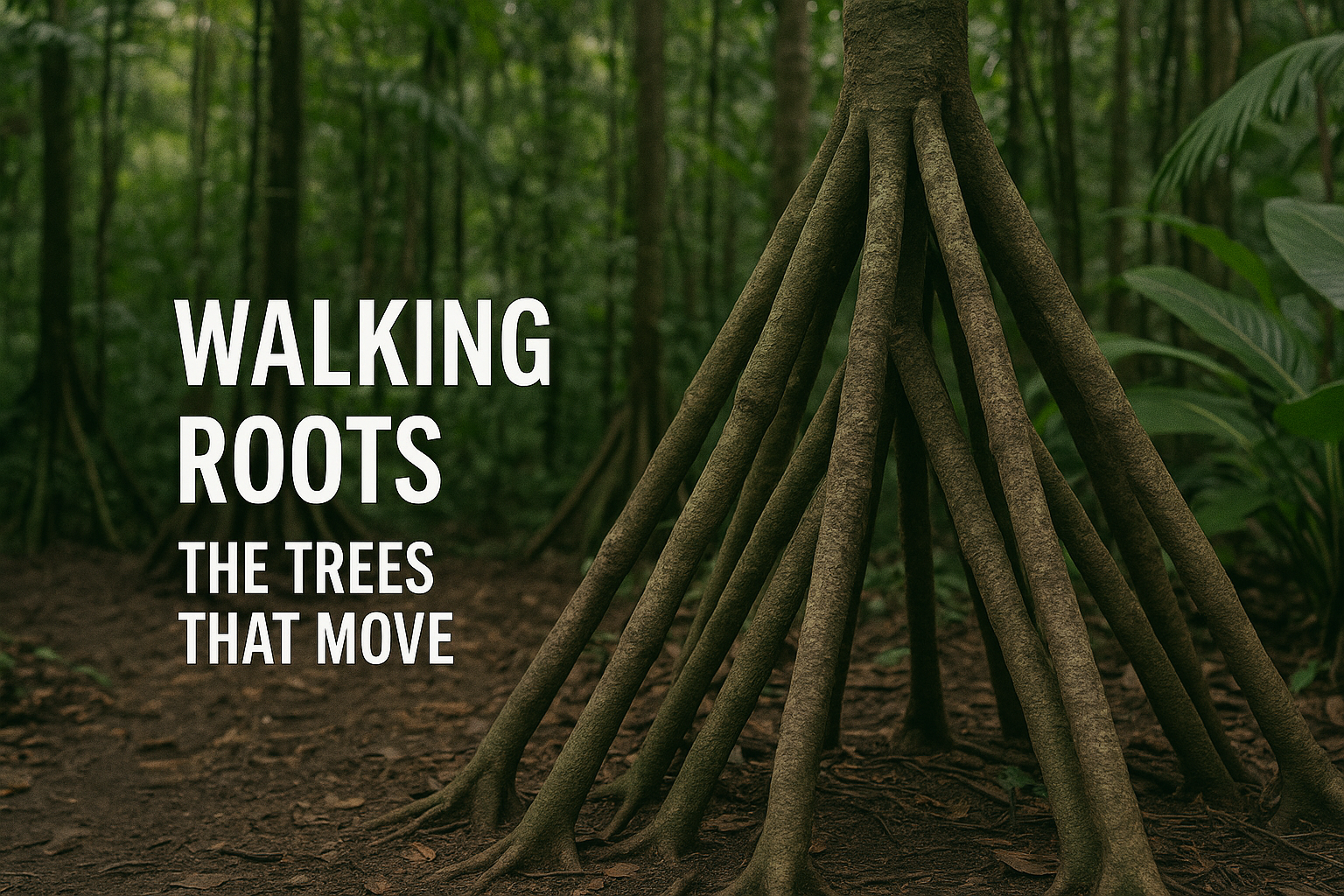

Most plants stay firmly rooted in one place—or so we think. Hidden in rainforests, deserts, and swamps around the world, a bizarre group of trees literally moves across the landscape, shifting position over time to seek sunlight, escape floods, or colonize new ground.
From the “walking palms” of Central America to Australia’s “running mangroves,” these botanical nomads challenge our understanding of plant behavior. This article explores how they move, why science once dismissed them as impossible, and what their unique adaptations could mean for flood-resistant crops and climate change survival.
The Science of Moving Trees
How Can a Tree “Walk”?
Unlike animals, plants don’t have muscles—but they use ingenious methods to relocate:
| Movement Type | Mechanism | Example Species |
|---|---|---|
| Root Walking | New roots grow toward light, old roots die | Socratea exorrhiza (Walking Palm) |
| Stem Creeping | Trunks elongate horizontally, sprouting new roots | Avicennia marina (Running Mangrove) |
| Tumbleweed | Dries out, detaches, rolls to disperse seeds | Ammobroma sonorae (Sand Food) |
| Crown Shyness | Branches “retreat” from neighbors to avoid competition | Dipterocarpus spp. (Asian canopy trees) |
5 Trees That Defy Immobility
1. The Walking Palm (Socratea exorrhiza)
-
Location: Amazon rainforest
-
Movement Rate: 2-3 cm/year
-
How It Works:
-
Grows stilt roots that slant downward
-
New roots emerge on the sunnier side
-
Old roots rot away, shifting the trunk
-
Myth vs. Reality:
-
Indigenous stories claim it “walks” to avoid being harvested.
-
Scientists confirm movement is real but slow—not conscious.
2. The Running Mangrove (Avicennia marina)
-
Location: Australian tidal flats
-
Movement Rate: Up to 1 meter/year
-
How It Works:
-
Saltwater kills roots on one side
-
New roots grow inland, dragging the tree
-
Survival Edge:
Escapes rising sea levels faster than other mangroves.
3. The Tumble Tree (Ammobroma sonorae)
-
Location: Sonoran Desert
-
Movement: Rolls like a tumbleweed when dry
-
Purpose:
-
Scatters seeds over 10+ miles
-
Re-anchors when rains return
-
4. The Dancing Birch (Betula pendula)
-
Location: Arctic tundra
-
Movement: Trunk “skates” on icy permafrost
-
Cause:
-
Freeze-thaw cycles shift shallow roots
-
Can migrate 50 cm in a single winter
-
5. The Nomadic Banyan (Ficus benghalensis)
-
Location: Indian subcontinent
-
Movement: Aerial roots colonize new ground
-
Record:
-
One tree in India “walked” 200 meters over 300 years
-
Why Do Trees Move? Evolutionary Advantages
1. Light Competition
-
Walking palms lean toward forest gaps where trees have fallen.
2. Flood Avoidance
-
Mangroves retreat from rising tides.
3. Nutrient Hunting
-
Tumbleweeds find untapped soil patches.
4. Climate Adaptation
-
Arctic trees drift toward cooler microclimates.
Controversy: Do They Really “Walk”?
The Scientific Debate
-
Skeptics argue movement is passive (erosion, soil shifts).
-
New research shows active root growth directionality.
Key Evidence
-
2023 laser scans proved walking palms reorient roots toward light.
-
Time-lapse footage shows mangroves “crawling” uphill.
Human Uses & Future Applications
1. Flood-Resistant Crops
-
Engineering walking-root genes into rice.
2. Erosion Control
-
Planting running mangroves to stabilize coasts.
3. Space Colonization
-
NASA studies tumbleweed plants for Mars terraforming.
4. Living Architecture
-
Guiding nomadic banyans to grow bridges.
Where to See Walking Trees
| Location | Species | Best Viewing Season |
|---|---|---|
| Amazon, Ecuador | Walking Palm | June-October (dry season) |
| Shark Bay, Australia | Running Mangrove | Year-round |
| Sonoran Desert, USA | Tumble Tree | After monsoon rains |
| Lapland, Finland | Dancing Birch | Winter (frost heave visible) |
| Kolkata, India | Nomadic Banyan | Any time |
Responsible Viewing Tips:
-
Never damage roots.
-
Use red light at night (mangroves are nocturnal nurseries).
Conclusion: Redefining Plant Intelligence
These wandering trees prove that mobility isn’t just for animals. As climate change accelerates, their strategies may become critical for forest migration and survival.
Next time you see a tree, look closer—it might not be where it was last year.


Leave a Comment