
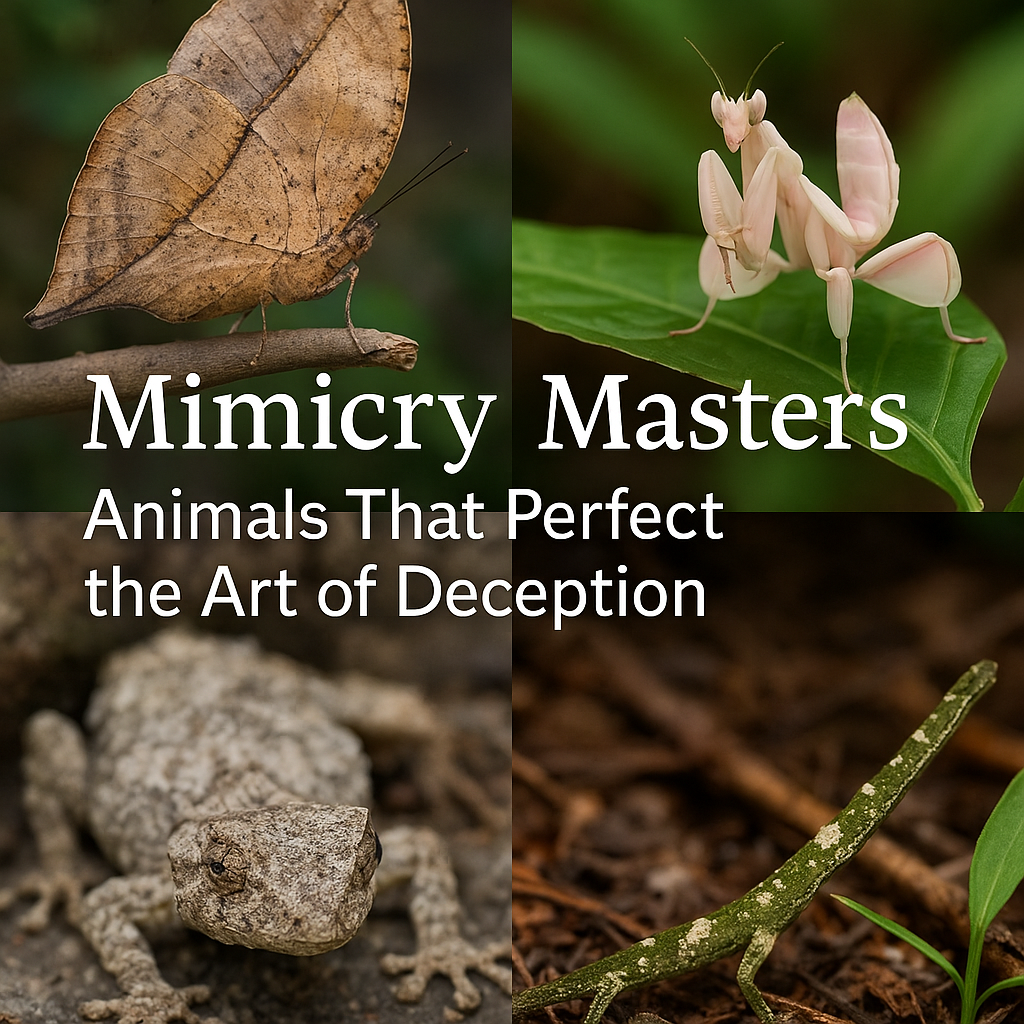

In the wild, survival often depends on deception. Some animals have evolved extraordinary abilities to mimic their surroundings, other species, or even inanimate objects to evade predators, ambush prey, or gain a reproductive advantage. This phenomenon, known as mimicry, is one of nature’s most fascinating adaptations.
From insects that look like leaves to fish that imitate rocks, the animal kingdom is filled with masters of disguise. In this article, we’ll explore some of the most incredible examples of mimicry in nature, how these adaptations benefit the animals, and why they are so effective.
What Is Mimicry?
Mimicry is an evolutionary strategy where one organism (the mimic) resembles another organism or object (the model) to gain a survival advantage. There are several types of mimicry, including:
-
Batesian Mimicry – A harmless species mimics a harmful one to avoid predation (e.g., a non-venomous snake resembling a venomous one).
-
Müllerian Mimicry – Two harmful species evolve to look alike, reinforcing avoidance by predators (e.g., bees and wasps sharing similar warning colors).
-
Aggressive Mimicry – Predators or parasites mimic harmless species to lure prey (e.g., an anglerfish using a bioluminescent lure).
-
Camouflage (Crypsis) – Blending into the environment to avoid detection (e.g., a stick insect resembling a twig).
Now, let’s dive into the most impressive mimicry masters in the animal kingdom.
1. The Leaf-Tailed Gecko – A Master of Disguise
Scientific Name: Uroplatus spp.
Habitat: Madagascar
The leaf-tailed gecko is a true illusionist. Its body resembles a dead leaf, complete with veins, discoloration, and even jagged edges. When resting on a tree, it flattens its body to eliminate shadows, making it nearly invisible.
Why It’s Effective:
-
Perfectly mimics decaying foliage, fooling predators like birds and snakes.
-
Can change skin color to match its surroundings.
-
Remains motionless during the day, enhancing its disguise.
2. The Mimic Octopus – The Ultimate Shape-Shifter
Scientific Name: Thaumoctopus mimicus
Habitat: Indo-Pacific region
Unlike most octopuses that rely on simple camouflage, the mimic octopus takes deception to another level. It can imitate at least 15 different species, including:
-
Lionfish (flaring its arms to mimic venomous spines)
-
Sea snakes (elongating two arms while hiding the rest)
-
Flatfish (flattening its body and swimming along the seabed)
Why It’s Effective:
-
Confuses predators by constantly changing its appearance.
-
Mimics dangerous animals to deter threats.
-
Uses dynamic color and texture changes for rapid adaptation.
3. The Orchid Mantis – A Flower in Disguise
Scientific Name: Hymenopus coronatus
Habitat: Southeast Asia
The orchid mantis is a stunning example of aggressive mimicry. Its bright pink and white coloration, along with petal-like limbs, make it nearly indistinguishable from an orchid flower.
Why It’s Effective:
-
Lures pollinators like bees and butterflies, which it then captures.
-
Even sways slightly to mimic a flower in the wind.
-
Predators overlook it, mistaking it for part of the plant.
4. The Walking Stick – Nature’s Perfect Twig
Scientific Name: Phasmatodea spp.
Habitat: Worldwide (mostly tropical regions)
Walking sticks are masters of crypsis, resembling twigs or branches so convincingly that even sharp-eyed predators struggle to spot them. Some species even have lichen-like patterns or fake bark textures for added realism.
Why It’s Effective:
-
Remains motionless for hours, blending seamlessly with vegetation.
-
Some species can regenerate lost limbs, ensuring survival if partially detected.
-
Releases a foul-smelling chemical when threatened as a last resort.
5. The Owl Butterfly – Eyes That Fool Predators
Scientific Name: Caligo spp.
Habitat: Central and South America
The owl butterfly has large, eye-like patterns on its wings that resemble the eyes of an owl. When threatened, it flashes these markings, startling predators like lizards and birds.
Why It’s Effective:
-
Mimics a larger, more dangerous animal (an owl) to scare off threats.
-
The sudden appearance of “eyes” triggers an instinctive fear response.
-
Its wing patterns also help break up its outline when resting on tree bark.
6. The Stonefish – The Deadly Rock
Scientific Name: Synanceia spp.
Habitat: Indo-Pacific coral reefs
The stonefish is the most venomous fish in the world, yet it looks like an ordinary rock. Its mottled, algae-covered skin allows it to lie motionless on the seabed, waiting for prey to swim by.
Why It’s Effective:
-
Predators and prey alike mistake it for an inanimate object.
-
Delivers a lethal venomous sting when stepped on or touched.
-
Can survive out of water for up to 24 hours, remaining hidden in tidal zones.
7. The Katydid – The Singing Leaf
Scientific Name: Tettigoniidae spp.
Habitat: Worldwide (mostly tropical)
Katydids are insects that mimic leaves with unbelievable precision. Some have vein-like patterns, brown edges resembling decay, and even fake bite marks to enhance their disguise.
Why It’s Effective:
-
Birds and reptiles overlook them as inedible foliage.
-
Their slow movements prevent detection.
-
Some species can even produce ultrasonic clicks to deter bats.
8. The Alligator Snapping Turtle – A Luring Predator
Scientific Name: Macrochelys temminckii
Habitat: Southeastern United States
This turtle uses aggressive mimicry by wiggling a worm-like appendage on its tongue. Fish mistake it for prey and swim close—only to be snapped up by one of nature’s strongest bite forces.
Why It’s Effective:
-
Mimics prey to lure fish into striking range.
-
Its algae-covered shell helps it blend into murky waters.
-
Can remain motionless for hours, conserving energy.
Conclusion: The Evolutionary Genius of Mimicry
Mimicry is one of evolution’s most brilliant survival strategies. Whether it’s a harmless butterfly pretending to be toxic, a gecko vanishing into bark, or an octopus impersonating multiple sea creatures, these masters of deception prove that sometimes, the best way to survive is to become someone—or something—else.
By studying these incredible adaptations, scientists gain insights into evolutionary biology, predator-prey dynamics, and even robotics (where camouflage tech is inspired by nature).
Final Thought:
Next time you walk through a forest or dive into a coral reef, look closely—what appears to be a leaf, twig, or rock might just be an animal perfecting the art of deception.

Leave a Comment