
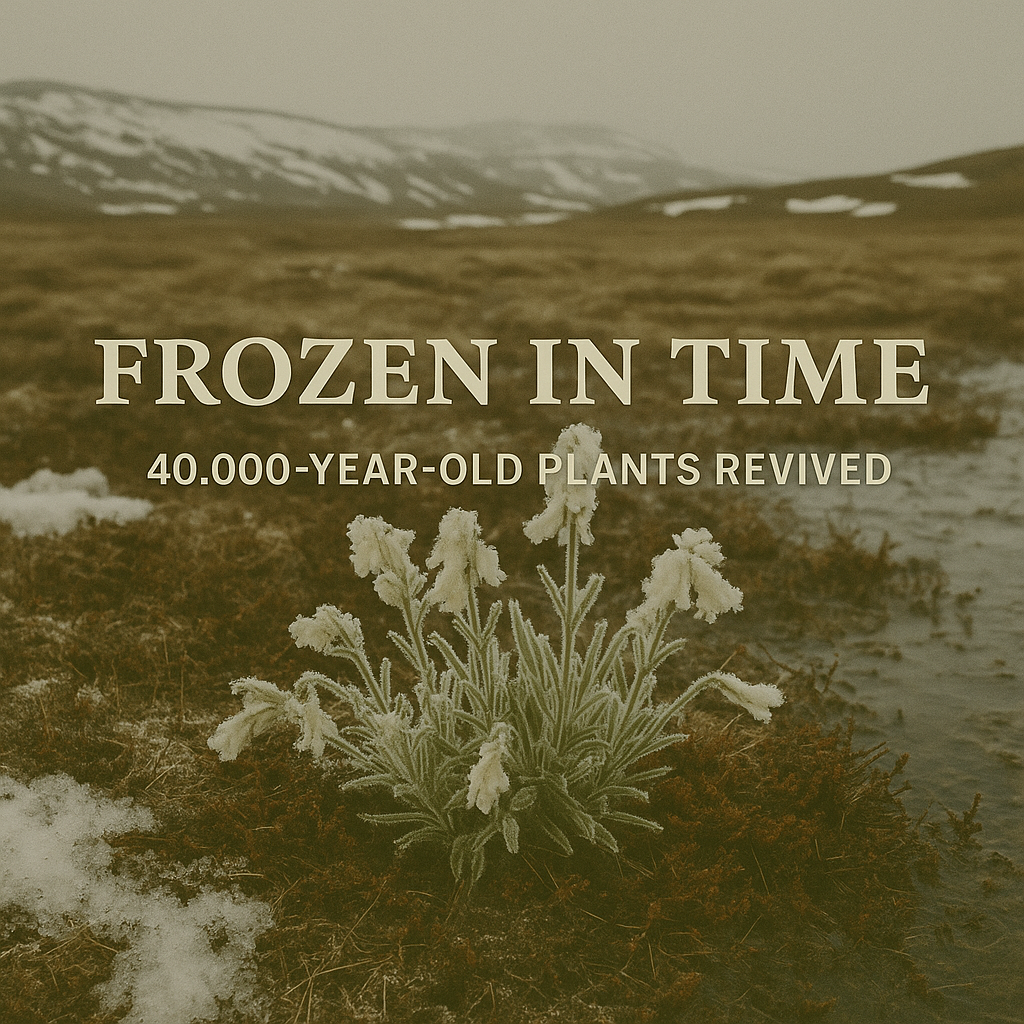

In the icy depths of Siberia’s permafrost, a team of Russian scientists made a discovery that blurred the line between past and present—ancient plants frozen for 40,000 years, brought back to life. These prehistoric specimens, buried since the last Ice Age, not only survived millennia in suspended animation but sprouted new growth when thawed, challenging our understanding of life’s resilience.
This breakthrough, first published in Proceedings of the National Academy of Sciences, opens doors to reviving extinct ecosystems, understanding climate change, and even preserving modern crops. But how did these plants cheat time? And what does their revival mean for science?
The Discovery: Ice Age Flora Resurrected
Where They Were Found
-
Siberian permafrost: A layer of permanently frozen soil acting as a natural time capsule.
-
Ancient squirrel burrows: Seeds and fruit tissues preserved in Pleistocene-era caches.
The Plants That Returned
-
Silene stenophylla (narrow-leafed campion): A flowering plant from the tundra.
-
Other mosses and grasses: Revived from 30,000–40,000-year-old material.
How Scientists Revived Ancient Plants
Step 1: Extracting Tissue
-
Scientists dissected immature fruit tissues (not seeds) from frozen burrows.
-
Unlike seeds, these tissues retained viable placental cells.
Step 2: Cloning Through Tissue Culture
-
Cells were cultured in a nutrient-rich gel, mimicking natural growth conditions.
-
After weeks, roots and shoots emerged.
Step 3: Comparing Ancient vs. Modern Plants
-
The revived plants were genetically identical to modern Silene stenophylla but with subtle differences in flower shape and root structure.
Why These Plants Survived 40000 Years
| Survival Factor | How It Helped |
|---|---|
| Permafrost Stability | Constant -7°C temps prevented decay |
| Natural Antifreeze | High sugar content in cells resisted ice damage |
| Deep Burial | Protected from radiation and oxygen |
| Desiccation Resistance | Dried tissues avoided crystallization |
Implications: What This Means for Science
1. Rewilding Extinct Ecosystems
-
Could Pleistocene Park (Siberia’s Ice Age rewilding project) use revived plants to restore ancient grasslands?
2. Climate Change Time Capsules
-
These plants lived when CO₂ levels were half of today’s. Studying them helps predict future plant adaptations.
3. Seed Banking & Crop Preservation
-
Techniques used here could extend seed vault storage (like Svalbard’s Doomsday Vault).
4. Space Colonization Clues
-
If plants survive millennia frozen on Earth, could they endure Mars or lunar conditions?
Challenges & Ethical Debates
1. Contamination Risks
-
Ancient pathogens could hitchhike on revived specimens.
2. De-Extinction Dilemma
-
Should we revive extinct species if their ecosystems are gone?
3. Permafrost Thawing
-
Climate change is exposing more frozen species—naturally. Should we intervene?
Other Organisms Revived from Permafrost
While plants are groundbreaking, scientists have also revived:
-
32,000-year-old bacteria (Actinobacteria).
-
24,000-year-old microscopic rotifers (multicellular animals).
-
Ancient viruses (like Pithovirus, though kept in controlled labs).
Could We Revive Mammoths Next?
The same Russian team (led by Dr. David Gilichinsky) inspired de-extinction projects like:
-
Woolly mammoth revival (using CRISPR-edited elephants).
-
Cave lion cloning attempts from frozen cubs.
But plants are simpler—no surrogate mothers needed.
How to See These Ancient Plants Today
-
Moscow’s Institute of Physicochemical and Biological Problems in Soil Science displays some specimens.
-
Documentaries: Genesis 2.0 (2018) covers permafrost discoveries.
Conclusion: Time Travel Through Botany
These resurrected plants are more than scientific curiosities—they’re living bridges to Earth’s past. As permafrost thaws and technology advances, we may uncover even older life waiting for a second chance.
One thing is certain: nature’s ability to endure, even after 40,000 years on ice, reminds us that life always finds a way.

Leave a Comment