
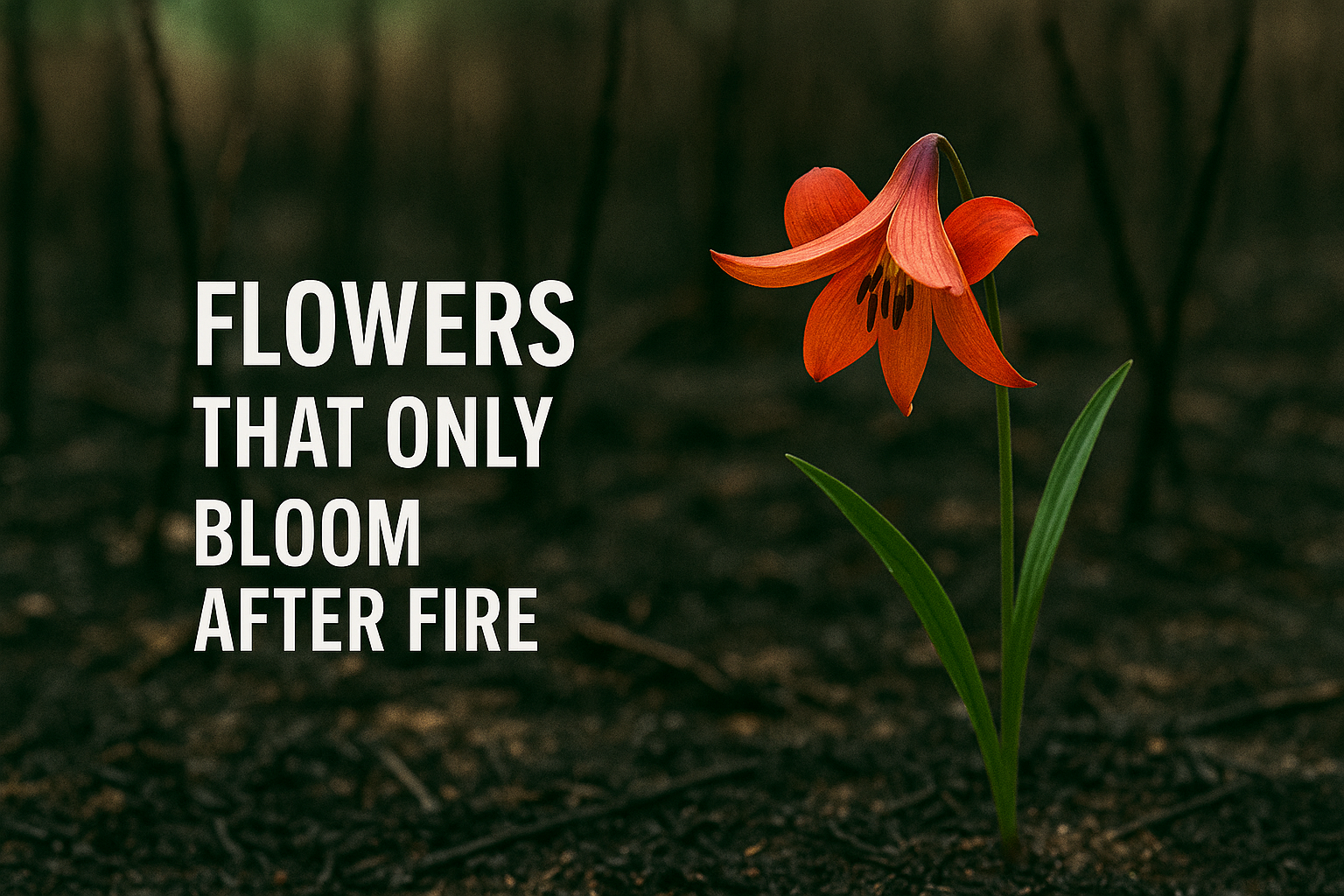

When wildfires ravage landscapes, most plants perish—but a mysterious group of flowers awaits the flames to burst into life. Known as pyrophytic plants, these fiery-dependent species lie dormant for years, sometimes decades, until fire clears their competition and triggers an explosive bloom.
From California’s post-fire superblooms to Australia’s flame-activated orchids, this article explores the science behind these fire-following flowers, their evolutionary secrets, and why they’re becoming crucial to ecosystem recovery in an era of climate change.
The Science of Fire-Activated Blooms
Why Fire? Evolutionary Advantages
-
Clears competitors – Eliminates taller plants blocking sunlight
-
Removes toxins – Some seeds are coated in fire-activated chemicals
-
Creates fertilizer – Ash provides nutrients like phosphorus
-
Triggers germination – Heat cracks seed coats; smoke chemicals signal growth
3 Types of Pyrophytic Plants
-
Obligate pyrophytes – Require fire to bloom (e.g., fire lilies)
-
Facultative pyrophytes – Bloom better after fire but don’t need it (e.g., certain lupines)
-
Smoke-dependent germinators – Respond to smoke chemicals (e.g., South African proteas)
7 Remarkable Fire-Following Flowers
| Flower | Region | Fire Secret | Bloom Time Post-Fire |
|---|---|---|---|
| Fire Lily (Cyrtanthus ventricosus) | South Africa | Bulbs survive underground | 48 hours |
| Chaparral Snapdragon (Antirrhinum kelloggii) | California | Smoke-activated seeds | 2 weeks |
| Giant Honey Flower (Melianthus major) | South Africa | Heat-triggered germination | 3 months |
| Ghost Orchid (Dendrophylax lindenii) | Florida swamps | Blooms after controlled burns | 1 year |
| Banksia (Banksia spp.) | Australia | Serotinous cones open in flames | 6 months |
| Fire Poppy (Papaver californicum) | Western USA | Only appears after wildfires | 8 weeks |
| Pyrophytic Lupine (Lupinus albifrons) | Mediterranean | Nitrogen-fixer, enriches soil | 4 weeks |
Fire Lily: The Fastest Phoenix
Record-Breaking Bloom
-
Native to South Africa’s fynbos (fire-prone shrublands)
-
Bulbs lie dormant for 20+ years waiting for fire
-
Flowers emerge within 48 hours of flames
Cultural Significance
-
Called “vuurlelie” (fire lily) by Dutch settlers
-
Symbolizes rebirth in African folklore
California’s Fire Poppy: A Rare Spectacle
Elusive Life Cycle
-
Seeds remain viable in soil for 50+ years
-
Only blooms when:
-
Fire occurs between March-June
-
Followed by gentle rains (not heavy downpours)
-
Conservation Concerns
-
Habitat loss makes sightings increasingly rare
-
2018 Woolsey Fire triggered first blooms in 30 years
Australia’s Banksia: The Fireproof Tree
Adaptive Genius
-
Serotinous cones sealed with resin melt in fire
-
Releases 100,000+ seeds per tree post-fire
-
Thick bark protects trunk from flames
Wildlife Lifeline
-
Nectar feeds endangered honey possums after fires
How Fire Flowers Help Ecosystems Recover
1. First Responders
-
Stabilize ash-covered soil with rapid roots
-
Prevent erosion before other plants return
2. Nutrient Cyclers
-
Lupines fix nitrogen, enriching barren ground
-
Ash-fed blooms attract pollinators
3. Biodiversity Boosters
-
Create microhabitats for insects and small mammals
Climate Change: A Threat to Fire Flowers
The Paradox
-
More frequent fires exhaust seed banks
-
Less intense fires fail to trigger germination
-
Invasive grasses outcompete native pyrophytes
Conservation Efforts
-
Seed banking projects (e.g., Australia’s Millennium Seed Bank)
-
Prescribed burns mimicking natural fire cycles
Can You Grow Fire Flowers at Home?
Best Species for Gardens
✔ Red Hot Poker (Kniphofia) – Smoke-treated seeds bloom yearly
✔ California Poppy – Responds to ash in soil
Artificial Fire Tricks
-
Smoke water soak – Simulates fire chemicals
-
Heat treatment – Bake seeds at 120°F for 5 minutes
-
Ash fertilizer – Sprinkle wood ash sparingly
Myths vs. Facts
❌ Myth: “All fire flowers are red.”
✅ Fact: Many are white/yellow (better visibility to night pollinators).
❌ Myth: “They cause wildfires.”
✅ Fact: They evolve in response to fire, not cause it.
❌ Myth: “Seeds explode in flames.”
✅ Fact: Most rely on heat/smoke cues, not direct burning.
Future Research & Applications
1. Post-Fire Restoration
-
Using pyrophytes to rehabilitate mining sites
2. Agricultural Innovations
-
Smoke-derived compounds (karrikins) boost crop yields
3. Climate Adaptation
-
Engineering fire-resilient crops with pyrophyte genes
Where to See Fire Blooms
Best Locations
-
Table Mountain NP, South Africa (August-September)
-
Banksia Woodlands, Australia (After summer fires)
-
California Superblooms (Spring following wildfires)
Responsible Viewing
-
Never pick or trample blooms
-
Support local fire ecology nonprofits
Conclusion: Beauty From Ashes
These fiery phoenixes remind us that destruction can bring renewal. As wildfires intensify globally, understanding pyrophytic flowers may hold keys to restoring scorched lands and adapting to a hotter future.
Their fleeting beauty—visible only when landscapes seem most devastated—offers a profound lesson in resilience and the cyclical nature of life.


Leave a Comment