
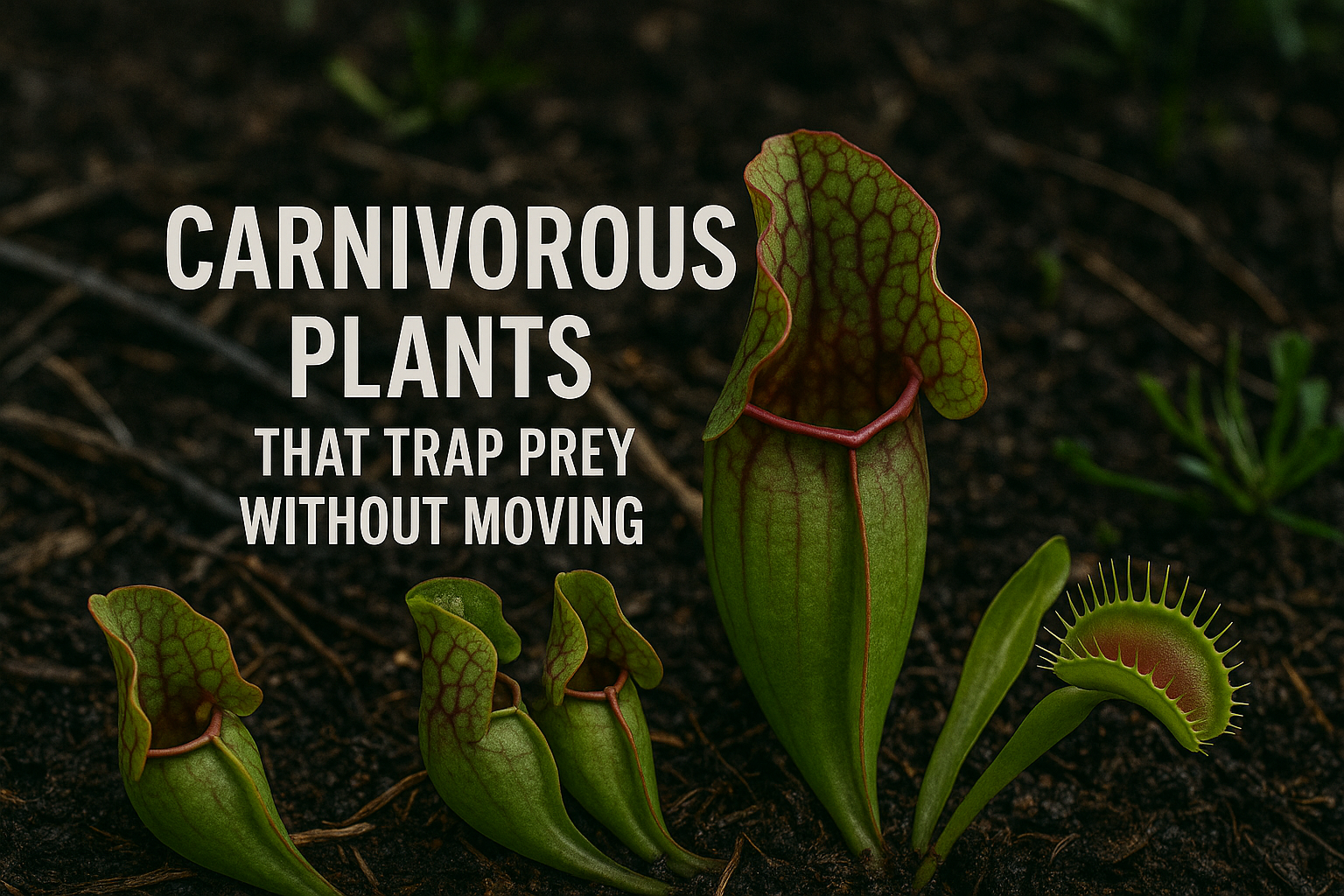

When we think of carnivorous plants, images of Venus flytraps snapping shut or pitcher plants drowning insects often come to mind. But some of nature’s most cunning predators don’t move at all—they use passive traps to capture prey with ingenious, motionless strategies.
These plants have evolved sticky surfaces, slippery slides, and deceptive lures to trap insects, small amphibians, and even mammals—without so much as a twitch.
This article explores the world of stationary carnivorous plants, their unique adaptations, and why scientists are fascinated by their energy-efficient hunting techniques.
How Do Plants Trap Prey Without Moving?
Unlike active trappers (like the Venus flytrap), passive carnivorous plants rely on:
✔ Adhesive mucilage – Sticky secretions glue prey in place.
✔ Slippery surfaces – Waxy coatings cause insects to fall into digestive fluids.
✔ Pitfall traps – Deep cavities prevent escape.
✔ Luring tactics – UV patterns, nectar bribes, or deceptive smells attract victims.
7 Deadliest Motionless Carnivorous Plants
| Plant | Trap Type | Prey | Unique Trick |
|---|---|---|---|
| Sundew (Drosera) | Sticky tentacles | Flies, ants | Glue + slow curling |
| Butterwort (Pinguicula) | Sticky leaves | Gnats, springtails | Disguised as harmless leaves |
| Pitcher Plant (Nepenthes) | Slippery pitfall | Insects, frogs, rats | Wettable rim causes falls |
| Corkscrew Plant (Genlisea) | Underground eel traps | Microscopic protozoa | Vacuum suction in soil |
| Rainbow Plant (Byblis) | Sticky hairs | Mosquitoes, beetles | Sparkles like dew in sunlight |
| Portuguese Sundew (Drosophyllum) | Flypaper leaves | Bees, wasps | Strong honey-like scent |
| Brochinia reducta (Bromeliad) | Tank trap | Ants, beetles | Reflective UV lure |
1. Sundews: The Silent Flypaper Assassins
How They Kill Without Moving
-
Tentacles ooze sticky mucilage that glues insects.
-
Leaves slowly curl over hours (not rapid movement).
Prey Specialization
-
Some species only catch mosquitoes, others target butterflies.
Scientific Insight
-
Their glue contains enzymes similar to spider silk.
2. Butterworts: The Disguised Killers
Trap Mechanism
-
Leaves look harmless but secrete digestive enzymes.
-
Prey struggles, triggering more enzyme release.
Habitat Hack
-
Grow on nutrient-poor cliffs, where insects are their only fertilizer.
3. Tropical Pitcher Plants: The Ultimate Passive Traps
Why They Don’t Need to Move
-
Peristome rim becomes slick when wet, causing slips.
-
Nectar bribes lure ants to their doom.
Largest Known Capture
-
Nepenthes rajah has trapped drowned rats.
4. Corkscrew Plants: Invisible Soil Predators
Underground Trapping
-
Hollow tubes suck in protozoa like an eel trap.
-
Only carnivorous plant that hunts in soil.
Scientific Mystery
-
How do they create suction without moving parts?
Why Passive Traps Are Evolutionary Genius
1. Energy Efficiency
-
Moving traps (like Venus flytraps) use 10x more ATP.
-
Passive plants save resources for growth.
2. Stealth Advantage
-
No sudden movements scare prey away.
3. 24/7 Trapping
-
Works rain or shine, day or night.
Human Uses & Scientific Research
1. Natural Pest Control
-
Pinguicula species used in greenhouses to control fungus gnats.
2. Bio-Inspired Engineering
-
Slippery coatings based on Nepenthes used in:
-
Self-cleaning windows
-
Medical devices (prevent bacterial adhesion)
-
3. Antibacterial Properties
-
Sundew glue contains compounds that kill bacteria.
Can You Grow These Plants at Home?
Best Beginner Species
✔ Cape Sundew (Drosera capensis) – Easy, prolific grower.
✔ Mexican Butterwort (Pinguicula moranensis) – Thrives on windowsills.
✔ Purple Pitcher Plant (Sarracenia purpurea) – Cold-hardy.
Care Tips
-
Distilled water only (tap water kills them).
-
Bright light (mimics their natural bog habitats).
-
No fertilizer (gets nutrients from prey).
Conservation: Many Are Endangered
Biggest Threats
-
Habitat destruction (bogs drained for agriculture).
-
Poaching (rare species sell for hundreds online).
How to Help
-
Buy nursery-propagated plants only.
-
Support bog conservation (e.g., International Carnivorous Plant Society).
Myths vs. Facts
❌ Myth: “They can eat humans.”
✅ Fact: Even giant Nepenthes only catch small rodents.
❌ Myth: “They move secretly.”
✅ Fact: True passive traps never move (unlike Venus flytraps).
❌ Myth: “They’re from outer space.”
✅ Fact: Evolved independently 6+ times on Earth.
Conclusion: Masters of Motionless Murder
These plants prove that you don’t need speed to be a killer. Through sticky secretions, slippery slides, and deceptive lures, they’ve turned stillness into a deadly advantage.
As research continues, their adaptations may inspire new pest control methods, medical adhesives, and self-cleaning materials—all from plants that never lift a finger.


Leave a Comment