
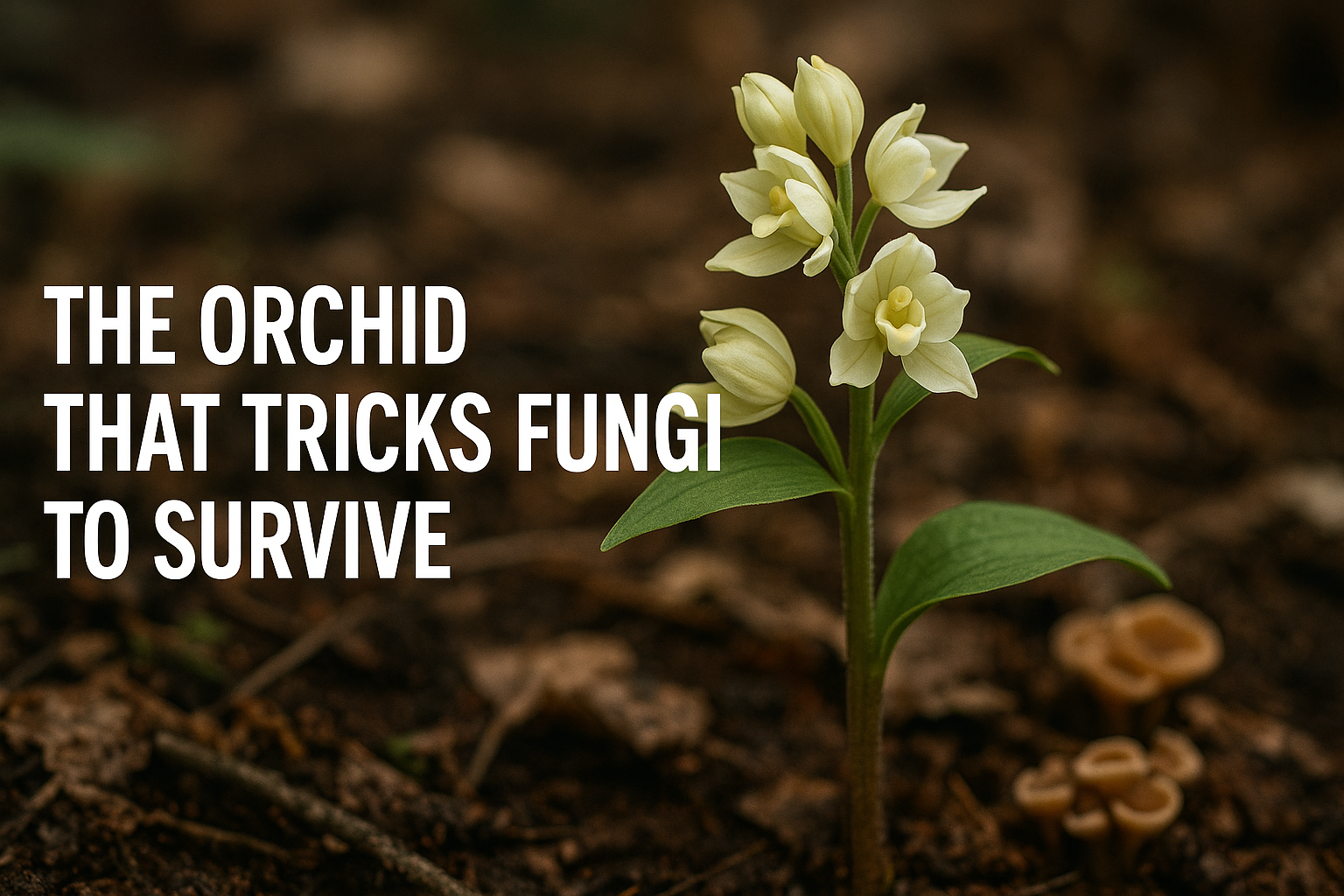

In the shadowy undergrowth of forests worldwide, a botanical con artist thrives—the orchid. While many plants rely on sunlight and soil, some orchids have evolved a devious survival strategy: they manipulate fungi into feeding them. This bizarre relationship, called mycoheterotrophy, turns the tables on nature’s rules, with orchids acting more like parasites than photosynthesizers.
From ghostly white orchids that vanish underground to species that mimic fungal scents, this article uncovers how these deceptive plants hijack fungal networks, why scientists are fascinated by their survival tactics, and what their strategies reveal about evolution, ecology, and even potential agricultural breakthroughs.
The Great Orchid Deception: How It Works
Most plants use photosynthesis, but some orchids—especially in dark, nutrient-poor forests—have given up sunlight entirely. Instead, they:
✔ Trick fungi into thinking they’re a partner (mycorrhiza).
✔ Steal nutrients from fungal networks connected to trees.
✔ Mimic chemical signals to keep the fungus fooled for life.
Key Players in the Scam
| Orchid Type | Fungal Target | Deception Method |
|---|---|---|
| Ghost Orchid (Dendrophylax lindenii) | Wood-decay fungi | Mimics fungal pheromones |
| Coralroot Orchid (Corallorhiza) | Russula fungi | Releases fake “food” signals |
| Underground Orchid (Rhizanthella) | Mycorrhizal fungi | Lives entirely below soil |
The Ghost Orchid: A Master of Chemical Mimicry
How It Tricks Fungi
-
The ghost orchid emits volatile compounds identical to those of decaying wood.
-
Fungi, thinking they’ve found a dead log to decompose, attach—only to be drained of nutrients.
Why It’s Nearly Extinct
-
Found only in Florida and Cuba’s swamps.
-
Poached relentlessly for its rarity (one plant sold for $10,000+ on black markets).
Coralroot Orchids: The Silent Thieves
Their Survival Strategy
-
Grow no green leaves (no photosynthesis).
-
Connect to Russula mushrooms, siphoning sugars from nearby trees.
-
Some species glow faintly to attract pollinators at night.
Scientific Discovery
-
DNA studies show entire orchid groups evolved to exploit specific fungi.
The Underground Orchid: A Botanical Vampire
The Most Extreme Case
-
Rhizanthella gardneri spends its entire life underground.
-
Discovered in 1928 when a farmer’s plow unearthed a pale, fleshy flower.
-
Relies on fungal highways to steal food from nearby shrubs.
Conservation Crisis
-
Fewer than 50 plants remain in Western Australia.
-
Threatened by soil compaction and climate change.
Why Fungi Fall for the Scam
Evolutionary Arms Race
-
Fungi usually trade nutrients with plants (mutualism).
-
Orchids hacked the system by mimicking signals.
The Cost to Fungi
-
Some fungi starve after feeding orchids.
-
Others adapt resistance, forcing orchids to refine their tricks.
Human Applications: What Orchids Teach Us
1. Agricultural Breakthroughs
-
Studying orchid-fungal deceit could help protect crops from parasitic fungi.
2. Medical Research
-
Orchid chemicals that manipulate fungi may lead to new antifungal drugs.
3. Conservation Clues
-
Protecting these orchids means preserving entire fungal networks.
Can You Grow These Orchids at Home?
Challenges
✖ Nearly impossible without exact fungal partners.
✖ Most die in cultivation due to complex needs.
Ethical Alternatives
✔ Support orchid conservation groups (e.g., Orchid Conservation Alliance).
✔ Grow non-parasitic orchids like Phalaenopsis (moth orchids).
Myths vs Facts
❌ Myth: “These orchids kill fungi.”
✅ Fact: They weaken but rarely kill their hosts.
❌ Myth: “They’re fungi themselves.”
✅ Fact: They’re true plants that lost photosynthesis.
❌ Myth: “All orchids do this.”
✅ Fact: Only ~200 of 28,000+ orchid species are full mycoheterotrophs.
Conclusion: Nature’s Ultimate Con Artists
These orchids reveal how evolution can twist relationships into elaborate survival scams. As science uncovers more secrets, their strategies may inspire sustainable farming, medicine, and new ways to combat climate-driven ecosystem collapse.
The next time you see an orchid, remember: some aren’t just beautiful—they’re master manipulators, thriving in the shadows by fooling fungi into servitude.

Leave a Comment