
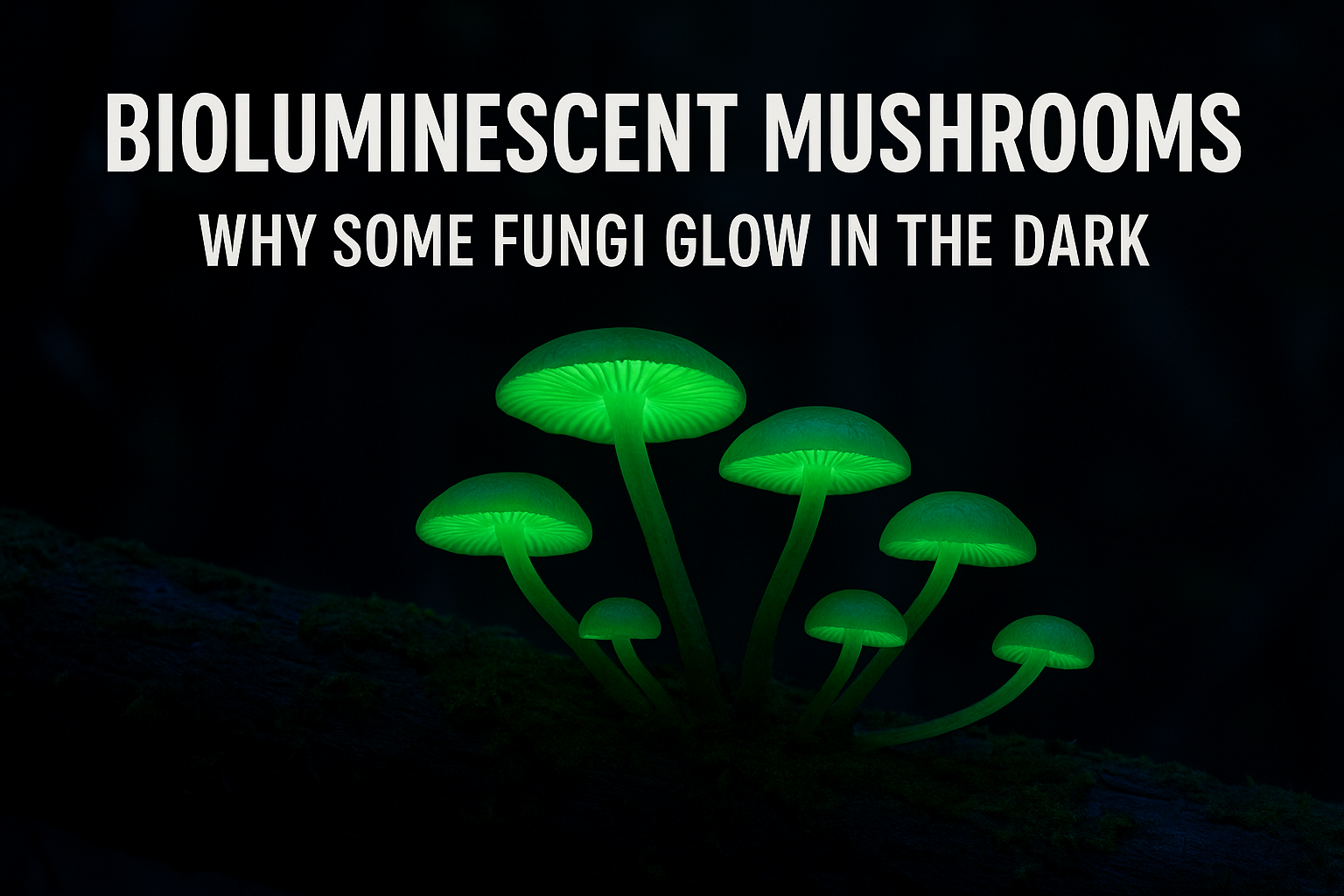

Deep in the world’s densest forests, a mysterious greenish-blue glow emanates from rotting logs and damp soil. This eerie light doesn’t come from fireflies or algae—it’s produced by bioluminescent mushrooms, one of nature’s most captivating phenomena.
Of the 100,000+ known fungal species, only about 80 glow in the dark. But why? Scientists have uncovered surprising reasons, from attracting insects to deterring predators, and even potential applications in medicine and sustainable lighting.
This article explores the science, myths, and future possibilities of these radiant fungi.
What Are Bioluminescent Mushrooms?
Bioluminescent fungi produce light through a chemical reaction involving:
-
Luciferin (a light-emitting molecule)
-
Luciferase (an enzyme that triggers the glow)
-
Oxygen (fuels the reaction)
Unlike fireflies, which use bioluminescence for mating signals, fungi glow 24/7—but it’s only visible in darkness.
Where They Grow
Most thrive in tropical and subtropical forests, including:
-
Brazil’s Atlantic Forest (home to the brightest species)
-
Japan’s Yakushima Island (famous for “green pepe” mushrooms)
-
U.S. Pacific Northwest (rare sightings of Armillaria mellea)
Why Do Mushrooms Glow? 4 Scientific Theories
1. The “Insect Lure” Hypothesis
-
Glow attracts nocturnal insects (beetles, flies) that spread spores.
-
Study: Mycena luxaeterna spores stick 2x better to glowing surfaces.
2. Predator Deterrent
-
Some fungi may glow to warn of toxicity (like poisonous frogs).
-
Unconfirmed but observed in Omphalotus olearius (“Jack-O’-Lantern mushroom”).
3. Metabolic Byproduct
-
Light could be a side effect of lignin digestion in decaying wood.
-
Similar to how deep-sea creatures glow from waste reactions.
4. Antioxidant Protection
-
Recent research suggests bioluminescence neutralizes harmful radicals in moist environments.
The 8 Most Spectacular Glowing Mushrooms
| Species | Glow Color | Where Found | Unique Trait |
|---|---|---|---|
| Mycena chlorophos | Green | Southeast Asia | Brightest glow (visible from 30m away) |
| Panellus stipticus | Blue-green | North America | Grows in clusters on dead wood |
| Omphalotus nidiformis | Yellow-green | Australia | Poisonous “ghost fungus” |
| Neonothopanus gardneri | Blue | Brazil | Called “flor de coco” by locals |
| Armillaria mellea | Faint yellow | Global (rare glowing) | Forms massive “humongous fungus” networks |
| Roridomyces phyllostachydis | Green | India | Grows exclusively on bamboo |
| Mycenoid sp. (Bioluminescent) | Blue | New Zealand | Only discovered in 2020 |
| Foxfire (Various species) | Green | Worldwide | Glowing mycelium in rotting logs |
Cultural Significance & Myths
1. “Foxfire” Folklore
-
Early Americans used glowing fungus to light trails at night.
-
Misattributed to foxes’ supernatural powers.
2. Japanese Legends
-
Called “shii no tomobishi” (“fire of the dead trees”).
-
Believed to be spirits of the forest.
3. Military Use in WWII
-
Japanese soldiers reportedly used bioluminescent fungi as natural nightlights in trenches.
Modern Science & Future Applications
1. Medical Breakthroughs
-
Luciferase enzymes are used in cancer research to track cell growth.
-
Potential for non-toxic medical imaging.
2. Sustainable Lighting
-
Experiments with glowing plant pathways using fungal DNA.
-
Could reduce electricity use in urban areas.
3. Pollution Detection
-
Some fungi glow brighter in toxic environments.
-
Being tested as living pollution sensors.
Can You Grow Glowing Mushrooms at Home?
Species to Try
✔ Panellus stipticus (Easiest to cultivate)
✔ Mycena chlorophos (Requires high humidity)
Step-by-Step Guide
-
Get a culture kit (available from specialty mycologists).
-
Use hardwood substrate (oak or maple sawdust works best).
-
Maintain 75°F and 90% humidity.
-
Wait 2-3 months for mycelium to colonize.
-
View glow in complete darkness (best after rain simulations).
Warning
-
Most bioluminescent mushrooms are inedible or poisonous.
-
Never harvest wild glowing fungi without expert ID.
Conservation: Are They Endangered?
-
Deforestation threatens tropical species.
-
Light pollution disrupts insect-spore relationships.
-
Brazil and Japan have protected some bioluminescent habitats.
Where to See Glowing Mushrooms in the Wild
1. Ribeira Valley, Brazil
-
Tours available during wet season (Dec-Mar).
2. Yakushima Island, Japan
-
UNESCO site with guided night hikes.
3. Florida’s Myakka River State Park
-
Rare Armillaria sightings after heavy rains.
Conclusion: Nature’s Living Nightlights
Bioluminescent mushrooms blur the line between biology and magic. Their glow—once a mystery—now inspires cutting-edge science, while ancient myths remind us of humanity’s fascination with the unknown.
As research continues, these luminous fungi may one day light our cities, cure diseases, or warn of environmental damage—proving nature’s solutions are often the most brilliant.


Leave a Comment